For Your Sake and Mine
Reading: John 18.1-19.16aTonight we are reading through the story of Jesus from his arrest to the crucifixion. It is a time that shows up each of the participants for what they were.
We see Jesus, committed to drinking the cup of suffering, protecting his friends, continuing to speak the truth of God, no matter what the consequences.
We see Judas the betrayer who leads soldiers and officials to arrest Jesus.
We see Peter - yes, the Peter who had been so convinced of his invinvible loyalty - drawing his sword in his Master's defence, yet going on to deny him three times.
We see the Jewish religious leaders whose agenda doesn't include finding out the truth - they had already prejudged Jesus.
We see Pilate with his passion for Roman correctness and justice caught in a political trap and incapable of administering justice, for a moment confronted with a truth that challenged his whole understanding of reality.
We see the crowd, manipulated and persuaded by popular opinion…
Yes, we see them all. Yet somehow we see ourselves too. "A man there lived in Galilee, unlike all men before…" As someone put it, he was "the man whom nobody could ignore". The question is, how do we respond to him?
Bible Reading: John 18.1-11
Arrested in the Garden
John doesn't record for us the prayer of Jesus in Gethsemane. That is recorded in the first three gospels - "My Father, if it is not possible for this cup to be taken away unless I drink it, may your will be done" (Mt. 26.42). We see Jesus refusing any form of self-defence and telling Peter, "Put your sword away! Shall I not drink the cup the Father has given me?" (Jn 18.11).
A few years ago a non-churchgoer gave his opinion that Jesus was a whimp. Anyone who didn't stand up for himself wasn't worth his salt. But there was nothing whimpish about Jesus. Here was the very Son of God refusing special divine protection.
Remember the temptations at the beginning of his ministry? "If you are the Son of God…" But Jesus had emptied himself. He had chosen "the form of a servant" - all the limitations of humanity. He had come on a mission - to seek and to save the lost, to give his life a ransom for many…
"I am he… If you are looking for me, then let these men go"
Bible Reading: John 18.12-18
Bible Reading: John 18.19-27
The rooster crowed -
His word was true -
But
The rooster crowed -
And I can crow
|
Denial
Peter didn't mean to deny Jesus. He had been quite sure that his commitment was greater than all the others (Mt. 26.33). He was prepared to lay down his life for Jesus (Jn 13.37). Though they were outnumbered, it was Peter who was prepared to strike out with the sword - a highly dangerous way of drawing attention to himself.
We cannot doubt Peter's good intentions and his sincerity. He knew what he meant to be and to do. He just didn't know himself. In the event, the bold blustery Peter just crumbled - I'm not one of his disciples. I wasn't with him in the olive grove.
We feel great sympathy for Peter. We don't mean to deny Jesus either. Perhaps we lie low so that nobody will suspect we are Christians.
But even the boldest among us can't "crow" - our "only boast the one who goes with steadfast love to meet the cross!"
Bible Reading: John 18.28-40
Pilate trained
The truth may kill.
But now before him stands
The truth may kill.
The case is clear -
The truth may kill.
A king, is he?
The truth may kill.
|
Pilate and the Truth
Like any judge, Pilate's responsibility was to find out the truth and to pronounce a verdict "without fear or favour".
The Jewish authorities were allowed a considerble latitude in determing cases which had to do with their law and were outside the interest of Roman law. They were insisting that Jesus was a criminal who should be executed. That would have to be carried out by the Roman authorities.
What was clear to Pilate was that Jesus had done nothing against Roman law. He suspected that the whole scheme was irregular in Jewish terms as well. But he was caught. Historians tell us that one complaint against Pilate had already been sent to Rome. He couldn't afford another. Yet what could he do with a man so obviously innocent.
Was Jesus' talk about a Kingdom a real threat to the rule of Rome? Well… in a real sense, the Kingdom of God does stand over against all earthly rule. But Jesus wasn't setting out to be a political ruler or to overthrow constituted authority. His Kingdom had something to do with the Truth. He had come to "testify to the truth".
What is the truth? Pilate didn't wait for an answer to his own most important question. Jesus had in fact claimed to be the Truth - "I am the way and the truth and the life. No one comes to the Father, except through me".
Bible Reading: John 19.1-6a
Crucify! Crucify!
Pilate had imagined that his offer to release Jesus or the notorious criminal, Barabbas, would have secured Jesus' release. In the Mel Gibson film, The Passion of the Christ, Barabbas is depicted as a real rogue. Although the people called out for his release, they pulled back when he was freed and ran down into the crowd.
In a further attempt to arouse the sympathy of the crowd for Jesus, he had him flogged. He presented Jesus to them - a brutalised pitiful figure. "Look, I am bringing him out to you to let you know that I find no basis for a charge against him". What a bizarre way to declare someone's innocence! "Here is the man!"
Bible Reading: John 19.6b-16a
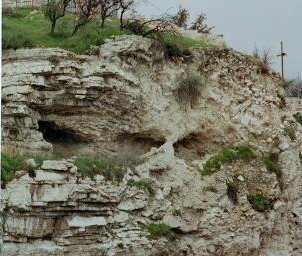
By a bus station
Is this
Two were dying
All wore
One cursed
Another
Remember you?
Golgotha,
| 
|
Committed
This year the sufferings of Jesus have been graphically portrayed on screen by the Mel Gibson film, The Passion of the Christ. The film is rated MA. It holds back nothing in the unrelenting brutality of Roman scourging and crucifixion. It isn't a film for the squeamish or faint-hearted. The reality of the scourging is recorded in the gospels without the detail. I am sure there are some people who shouldn't go to see it. I commend it to those who should.
Over forty years ago I read about what was involved in Roman scourging and crucifixion in Alfred Edersheim's Life and Times of Jesus the Messiah which came out in 1883-1890. Edersheim was born in Vienna of Jewish parents. Mel Gibson's film closely matches his description. Scourging is described as the introduction to crucifixion - "the intermediate death". The film-maker has done his homework thoroughly and, as the Pope said after viewing the film, "It is as it was".
Of course, we have thought we are superior, above all that sort of violence. We haven't believed human evil is a bad as that - that is, until September 11 and Bali, or until we have read some of the reports of Amnesty International. It is part of our world, and, more than we like to acknowledge, it is becoming part of our society too.
Our other objection is that we don't believe that level of suffering was necessary for the atonement of human sin - not our sins, anyway!
At one point in the film, Mary is in the background and says under her breath, "Jesus, when are you going to stop all this?"
But Jesus was committed - committed to accept all that suffering, no turning back. He would go through it all - for your sake and mine!
© Peter J. Blackburn, Maundy Thursday, Ayr Uniting Church, 8 April 2004
Scripture readings, poems and portions of meditation were interspersed with songs, hymns and prayers.
Except where otherwise noted, Scripture quotations are from the New International Version, © International Bible Society, 1984.
Back to Easter Sermons
Back to Sermons